

An SNS iHub perspective on sustainability, infrastructure, and responsible AI growth
The global artificial intelligence boom is often framed as a story of innovation, productivity, and progress. But behind the optimism lies a growing contradiction, AI’s explosive growth is quietly triggering an environmental cost that the technology industry is struggling to reconcile.
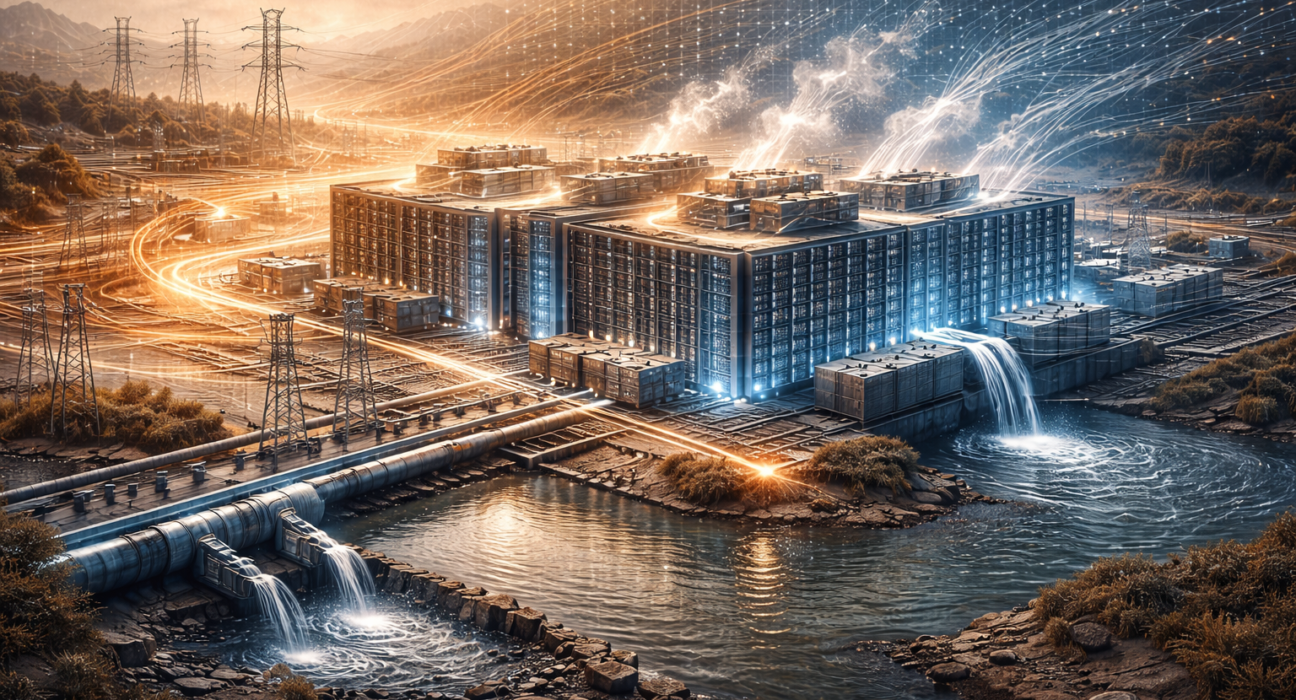
As AI models become larger, more autonomous, and more compute-intensive, the infrastructure required to run them has expanded at an unprecedented pace. Data centers, the physical backbone of AI—are now at the center of an escalating arms race, one with profound implications for energy systems, water resources, and climate commitments worldwide.
AI’s Infrastructure Reality: Growth at Any Cost?
Recent industry estimates suggest data center energy demand could grow by nearly 160% by 2030, driven primarily by AI workloads. What was once a relatively efficient digital sector is rapidly transforming into one of the world’s most energy-intensive industries.
Major technology firms continue to position AI as a solution to global challenges, from climate modeling to healthcare optimization. Yet, at the same time, their carbon emissions and resource consumption are rising sharply, revealing a widening gap between sustainability pledges and operational reality.
For many enterprises, the urgency to scale AI capabilities has overtaken longer-term environmental planning. The result is a wave of hyperscale data center construction that is testing the limits of local grids and natural resources.
The Sustainability Disconnect
Over the past decade, leading tech companies have made ambitious climate commitments, net-zero targets, carbon-negative roadmaps, and renewable energy pledges. However, AI infrastructure expansion has complicated those goals.
Rather than reducing absolute emissions, many organizations are relying on offsets, renewable energy credits, and accounting mechanisms to balance the books, while their real-world energy footprint continues to expand. This approach may satisfy reporting requirements, but it does little to ease pressure on power systems or communities hosting large-scale data centers.
At SNS iHub, this pattern highlights a broader challenge in emerging technologies: innovation cycles are moving faster than governance and sustainability frameworks.
The Overlooked Crisis: Water Consumption
Energy is only part of the story. Large AI data centers require enormous volumes of water for cooling—often in regions already facing water stress.
Training a single large AI model can consume hundreds of thousands of liters of freshwater, factoring in both direct cooling and power generation. As models scale, so does water usage, often without transparent disclosure.

In several regions, communities are beginning to question whether AI infrastructure growth aligns with local sustainability priorities. The lack of visibility into water consumption data has made it harder for policymakers and citizens to make informed decisions.
Why Renewables Alone Are Not Enough
While renewable energy adoption continues to grow, AI workloads demand continuous, 24/7 power availability. This has led some technology companies to explore alternatives such as nuclear energy to meet baseload requirements.
These moves signal a difficult truth: current AI growth trajectories cannot be supported by renewables alone, at least not without massive upgrades to grid infrastructure and storage capacity. This introduces new trade-offs around cost, risk, and long-term environmental impact.
The Innovation Paradox
AI is increasingly being used to optimize data center efficiency, improving cooling, load balancing, and energy utilization. These gains are real and important.
However, they are being outpaced by the exponential increase in AI computation itself. More efficient systems have enabled more use cases, which in turn demand even more infrastructure. This creates a cycle where efficiency improvements fuel, rather than reduce, total resource consumption.
The question facing enterprises is no longer whether AI can be optimized—but whether unconstrained scale is the right strategy.
A Shift Toward Accountability
Governments and regulators are beginning to respond. Environmental impact disclosures, grid connection limits, and sustainability assessments for new data centers are becoming more common in key markets.
This signals a turning point. AI infrastructure can no longer be treated as invisible or purely digital. It must be planned as critical physical infrastructure, with the same scrutiny applied to energy plants, factories, or transportation networks.
Rethinking Responsible AI at Scale
From an SNS iHub lens, the path forward is not about slowing innovation, but aligning AI growth with responsible system design. That means:
- Prioritizing AI use cases with clear societal and economic value
- Investing in smaller, more efficient, domain-specific models
- Designing AI infrastructure with regional energy and water realities in mind
- Treating sustainability as a core architectural constraint, not a reporting afterthought
The future of AI will be shaped not just by what models can do, but by what ecosystems can support sustainably.
The Question That Matters Most
AI has the potential to help solve some of the world’s hardest problems. But if its growth accelerates environmental stress, it risks becoming part of the problem it claims to address.
The real challenge ahead is not technological, it is strategic.
Can the AI industry balance ambition with responsibility, and innovation with restraint?
How that question is answered will define whether AI becomes a force for sustainable progress, or a cautionary tale of unchecked scale.